Lake Titicaca & Puno Travel Guide


About Puno and Lake Titicaca
The Folklore Capital of Peru
Puno city is the capital of the department of Puno. It was founded with the name of "Villa Rica de San Carlos de Puno" in 1668, by the Viceroy Count of Lemos, to end with the problems of possession of the silver mines of Laicacota of the brothers Gaspar and José Salcedo.
Lake port beside the Titicaca, the highest navigable lake in the world. It have landscapes of indescribable beauty, it has been the origin and cradle of big pre-Hispanic civilizations as Tiahuanaco, Collas, Quechuas and Aymaras, and of the mythical legend of Manco Capac and Mama Ocllo who emerged of its waters and went to Cuzco to found the capital of the Inca empire.
Living Culture: The Uros, famous and ancestral people that live in floating artificial islands, or the indigenous communities of Taquile and Amantani that maintain their customs and rites without changes in the course of the time, amid unique landscapes.
Very near the city you will find interesting archaeological remains of Pre-Hispanic cultures, as the chullpas of Sillustani inside the Ecological Reserve of Umayo, Pucará, or old cities of Spanish foundation as Chucuito, Juli and Pomata that harbor jewels of the architecture and colonial art, expressed in their temples and churches that flourished as product of the fortune of the silver mines of this region and the Spanish conquest of the Paraguay and of the Mojos.
The native resident of Puno is of the ethnos Aymara (12.9% population of Peru); their language is the Aymara. For the subsistence in height average of 4,000 meters above sea level (13,122 feet) and with a cold climate, they have achieved an excellent adaptation. The color of its skin is dark, high lung capacity and development of the thorax; they have two more litters of blood then the average, with high content of red globules, what grant them great physical resistance. Many of them are dedicated to the elaboration of beautiful crafts and fine fabrics in alpaca wool.
In the plateau and mountains of Puno it will be common to find herds of llamas and alpacas, being the area of more intense development of this cattle raising, originating beautiful panoramas in places where trees and vegetation almost not exist.
Puno Overview
-
Location:
South Andean zone, plateau, 12,555 feet (3,827 m.) above sea level, on the shore of Lake Titicaca.
-
Distances to Puno
-
Population:
229,000 inhabitants
Puno Maps

|
|||
|
|||
Lake Titicaca (Photo © J. Mazzotti) |
|||
|
|||
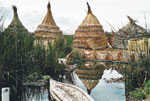
Uro's Island Lake Titicaca
(Photo © J. Mazzotti) |
|||
|
|||
Chullpas of Sillustani
(Photo © J. Mazzotti) |
|||
|
|||
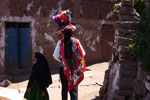
Natives in Taquile Island
(Photo © J. Mazzotti) |
|||
|
|||
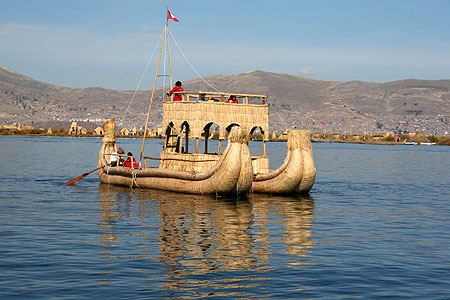
Reed-boat in Uro's Island Lake Titicaca (Photo © J. Mazzotti) |
|||
|
|||
Natives in Taquile Island (Photo © P. Godoy) |
|||
|
|||
Cathedral of Puno (Photo © J. Mazzotti) |
|||





Puno Guide - Visiting Lake Titicaca and Puno
A visitor arrives in Puno with one look on his face and leaves with an entirely different one, more real and lasting. Maybe it is the humbling presence of the Titicaca, out of whose sparkling waters rise ancient legends. Or, perhaps it is the fantastic looking Sillustani chullpas (burial towers) lining the lake shore. Who knows. The splendor of its churches is equally hard to forget, such as Saint Dominic in Chucuito, built in 1534 and being the first and oldest church on this high plateau. It is also likely that Puno's enchantment rests in its people, their reserved nature, yet their joy, and the way they welcome visitors. Maybe it is all the aforementioned reasons everything added together.
Puno City: The beauty and charm of the city, are a mixture of their typical constructions of Andean architecture in the sides of the hills until the bank of the Titicaca Lake, and that of their people, humble, poor and kind. Visit Plaza de Armas, the Cathedral, La Casa del Corregidor 17th Century (Deustua Nº 576), the Arco Deustua, Huasajpata Park and the new Mirador del Condor.
Museums in Puno: It has modest museums of regional archaeological pieces as the Museo Municipal Carlos Dreyer (Municipal Museum Dreyer) located in Conde de Lemos Nº 289 and the Museo de Arte Popular de Puno (Museum of Popular Art of Puno).
Lake Titicaca: The highest navigable lake in the world where going through their waters is to travel by beautiful landscapes having for nice scenery the snowy mountain of the Cordillera Real (Real Mountain range) of Bolivia. Inside the lake exist a protected area of the natural ecosystem, you can also visit the islands of Uros, Taquile and Amantani, or carry out a short cruise to Copacabana and Sun Island in Bolivia.
Floating Islands of the Uros: Lake Titicaca's top tourist attraction. Old descending Aymaras that build their houses over floating artificial islands that elaborate themselves on the waters of the Titicaca, in which they inhabit in organizations and with ancestral customs. The tourists can lodge in the houses of the natives and enjoy several days them and their local customs.
Amantani and Taquile Islands: These islands offer to tourists an authentic travel to the past, sharing the life with local natives and beautiful landscapes. The tourist are accommodation in a family house and all activities will be with natives. Is a real experience of rural tourism. In these areas visitors come into contact with ancient communities, and have the opportunity to share their ways of life and see their splendid textiles. Conscious of the value that living cultures mean to travelers from every corner of the world, a number of communities in Puno have opened to rural and experienced based tourism, both in the island and on land. It is there were the ventures of Taquile, Amantani, Uros and Llachon can be found. The visitor to Amantani or Taquile islands will visit Uros island on the route. Recommended program 2 days / 1 night.
Taquile Island Oral and Intangible Heritage of Humanity: UNESCO proclaimed to Taquile Island and its textile art as a Oral and Intangible Heritage of Humanity. Taquile Island is known for its textile art, which is produced as an everyday activity by both men and women, regardless of their age, and worn by all community members. The weaving tradition on Taquile island goes back to the ancient Inca, Pukara and Colla civilizations; it thus keeps elements from pre-Hispanic Andean cultures alive in the present. Besides Aymara and Spanish, the Taquile people speak Quechua, an indigenous language of Peru.
Archaeological places of Puno: On the area of Puno flourished old pre-Inca civilizations like Tiahuanaco, Pucará and then the Inca. The best legacies are the chullpas of Sillustani and Kalasaya the fortress and citadel of Pucará and his Museo Litico Pucará.
Around Puno: Cities and small towns that flourished to the banks of the Lake Titicaca keep architectonic colonial jewels, out stands Chucuito, Juli, Pomata, Yunguyo, these cities can be visited in the route to Desaguadero or Copacabana - Bolivia. At the north route Juliaca, Llachón, Lampa and Pucará.
Folk and Art: Puno has been denominated the "Capital folklórica del Peru" (folkloric capital of Peru) by the wealth of its artistic and cultural expressions. Especially through the dance; there are registered more than 300 from the 1,500 existing in the national environment, autochthonous dances that reach their biggest manifestation in the celebrations of the Feast of the "Virgen de la Candelaria" and the Regional Contest of Autochthonous Dances. Calendar of Feasts.
Virgen de la Candelaria Feast: The Feast in honor of Our Lady of Candlemas, patron of the city of Puno, is made in the first fortnight of February each year, and represents the largest and most important cultural event, musical and dancing by Peru, and one of the three most significant in South America along with Carnival in Rio de Janeiro and the Carnaval de Oruro, in the amount of symbols and artistic and cultural manifestations of the cultures themselves Quechua, Aymara and mixed by Highlands Andean and the volume of people directly and indirectly involved in its realization.
Yavari Project : This steamship was build in United Kingdom in 1861, then was discharged in packing cases and pieces in Peruvian port of Arica, from where incredibly being hauled by mule over the Andes to Puno, that took 6 years to complete. Now is registered as Museum, berthed in Puno Bay, outside the Sonesta Posada Hotel del Inca Puno.
For the proximity among certain destinations, you can plan the following recommended circuits: (Start point: Lima)
 LAKE TITICACA AND PUNO - PHOTO GALLERY.
- Puno City
- Andean Explorer Train
from Cuzco to Lake Titicaca - Lake Titicaca
- Sillustani Archaeological Site
- Pucara - Museum and Church
- San Juan Bautista Church
- Amantani Island
- Taquile Island
- Uros Islands
- Yavari Project
- People of Taquile Island
- Uros Islands - People
- Uros Islands - Reed boats and Houses
- Dances of Puno
- San Santiago Feast in Puno
- San Santiago Feast in Taquile Island
- Virgin of Candelaria Feast - Yellow
- Virgin of Candelaria Feast - Green
- Virgin of Candelaria Feast - Blue
- Virgin of Candelaria Feast - Red
BOLIVIAN AREA (NEXT TO PUNO) - PHOTO GALLERY.
 LAKE TITICACA, PUNO TRAVEL GUIDE - SEE ALSO:
- Lake Titicaca & Puno Travel Guide
- Puno City
- Lake Titicaca
- Uros Islands
- Taquile and Amantani Islands
- Taquile Island Intangible Heritage