Paracas Travel Guide


About Paracas
Paracas is an excellent nature and biodiversity destination,
it also offers cultural historical attractiveness and
it is a good alternative to enjoy relaxing moments
The desert and the sea come together in spectacular landscapes in Paracas, in the department of Ica, just a few hours south from Lima. The cliffs that fringe the beaches are teeming with life, millions of birds that live here year-round, and thousands of others that fly from the northern hemisphere and from further south, ranging from guano birds to Humboldt penguins.
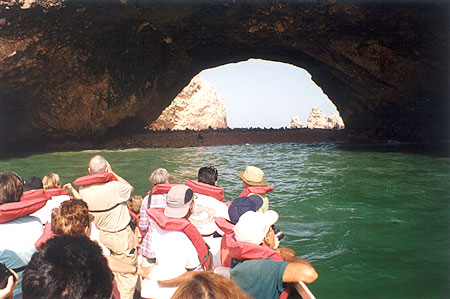
Boats departure from El Chaco to Islas Ballestas (Ballestas Islands), giving visitors a chance to gaze at the sea lion colonies, millions of birds and you'll see the famous three-pronged Candelabra geoglyph, carved into the sand with a similar technique to the Nazca Lines, although possibly of a different origin: theories range from pirates marking a treasure hiding place to soldiers fighting for Latin-American independence from Spain.
By car, or buggies, you can visit the terrestrial area of Paracas National Reserve and enjoy the desert dunes. Back on the traditional circuit, the road leads to the on-site museum and the necropolis and ruins of the burial grounds of the Paracas culture (700 BC.), whose weaving skills have been admired the world over. A trail leads down to a protected bay, the natural habitat of flamingoes, the scarlet-and-white birds that inspired the colors of the Peruvian flag. They are not to be disturbed. Further south lie the striking natural rock formations of the Catedral (Cathedral) and Mendieta.
At sunset, the Paracas coast spins through a range of colors, the signal for nostalgic visitors to return to the city.
Paracas City Overview
-
Location:
Central Coast, 16.4 feet (5 m) above sea level in front Ocean Pacific
-
Distances to Paracas:
-
Population:
1,196 inhabitants
Maps of Paracas

|
|||
|
|||
El Chaco - Paracas (Photo © J. Mazzotti) |
|||
|
|||
Paracas urban area (Photo © J. Mazzotti) |
|||
|
|||
Sand dunes in Paracas desert |
|||
|
|||
The Cathedral before the earthquake 2007 (Photo © J. Mazzotti) |
|||
|
|||
Doubletree by Hilton Resort Paracas (Photo © Hilton Paracas) |
|||
|
|||
Ballestas Island Tour (Photo © J. Mazzotti) |
|||


Paracas Guide
Paracas is a spa - village, a peninsula, a bay, a pre-Inca Culture and a National Reserve. Its amazing for birdwatchers and hikers. Paracas has places of historical and archaeological special interest.
Paracas Village: Located at 9.3 miles (15 Km) south of Pisco town and 152 miles (245 Km) from Lima. It is a place of gentle beaches and sunny weather most of the year. The best hotels are located around Paracas Bay. Very close by a picturesque creek of fishermen called El Chaco and a residential area are located. It is the starting point to visit the fantastic attractions that are located around Paracas. In Paracas you will find from luxury hotels to economic accommodations, alternatives for the practice of water sports in private clubs or hotels, excellent seafood and enjoy the famous Peruvian Pisco Sour cocktail. Internet services, ATMs, laundry, medical services, market and handicraft shopping area. ATV and bicycle rentals. Buggies and sandboarding has become popular on the sand dunes, an ideal area to take to the steep sandy slopes of the desert.
Reserva Nacional de Paracas (Paracas National Reserve) : Nature and ecology lovers will find the only marine reservation of Peru in this place. This reserve is dedicated to the protection and the conservation of marine ecosystems as well as for the protection of the cultural and historical patrimony of the pre-Inca Paracas culture. It is considered as one of the richest and most uncommon ecosystems in the world; many tour operators offers you a tour to the reserve.
Ballestas Islands: A collection of islands which are off limits to people, but boat tours can get close. They are located outside the reserve area. They constitute the habitat of a great variety of sea birds, sea lions, turtles and dolphins. Nicknamed the poor man's Galapagos. This excursion is one of the most regular ones from Paracas.
Julio C. Tello Site Museum: Located very near the Paracas village (5 Km), of small size, it possesses an interesting exhibition of the evolutionary process of the Paracas Culture, textiles, ceramics and reproductions of their daily life. Near the museum is the Paracas Necropolis (100 B.C.-A.D. 300), comprising the archaeological sites of Cabezas Largas and Cerro Colorado.
Tambo Colorado: Archaeological place located in Kilometer marker 45 of the Libertadores Highway. It is a very well preserved Inca urban center, possibly built during the time of the Inca Pachacutec as a lodge for soldiers and high-level authorities.
Paracas Peninsula: Is a desert peninsula within the boundaries of Paracas National Reserve. On this peninsula, on a sandy hillside, the enigmatic figure of the Candelabra is found. This candelabra, with its trident form, belongs to pre-Inca cultures. It is yet to be determined its meaning. The best way to appreciate this figure is from a boat in a tour to Ballestas Islands. These boats normally offer rides to visit the Paracas Natural Reserve as well as the Ballestas Islands, which allow an excellent view of the Candelabra. Puerto San Martin a shipping port was built along the northern peninsula.
Bay of Paracas : This bay is formed on the north part of the peninsula of Paracas, and has special historical significance for Peruvians, since it was here where José de San Martín disembark with the liberation forces, began the campaign for independence to end the Spanish viceroyalty. An obelisk reminder to this historical event. On the beaches of this bay, normally in Sequion beach, is frequent to find Andean parihuanas (flamingos), of beautiful red and white plumage, which inspired José de San Martín for the Peruvian flag.
Pisco: 6 Km. west of the Pan-American Highway. Town founded in 1640, is the capital of the province of the same name in the department of Ica (52,100 inhabitants), divided in Pisco town and Pisco port. Some colonial buildings. The picturesque fishermen's wharf of San Andrés is located on its beaches, in which numerous popular restaurants of seafood also exist characterized by the simplicity of its presentation, yet exquisite typical food. The town suffered severe damages by the 2007 earthquake. Pisco has an airport, no regular flights, is used only for companies that overflight the Nazca Lines, also the bus station. The Pisco's port was disabled for marine traffic; being displaced by the modern port of San Martín, located in Punta Pejerrey, on the peninsula of Paracas.
San Gallán Island: Located to 1.5 hour boat ride from El Chaco - Paracas is a special place for surfers wiht finest right-breaking wave, tubular and long waves.
We recommend you visit combined Paracas and Nazca.

 PARACAS TRAVEL GUIDE - SEE ALSO: